
Effective Workout Plan Design for Optimal Fitness Results
Designing a fitness regimen that delivers tangible results requires more than random exercise selection. I have spent years analyzing training methodologies, and I can confidently state that effective workout plan design is the cornerstone of any successful fitness journey. Without a structured approach, progress stalls, and motivation wanes. This guide provides a comprehensive framework for creating a program tailored to your goals, whether you are a beginner or an advanced athlete. I will walk you through the core principles, weekly scheduling, nuances of strength training, and advanced cardio strategies. By the end of this article, you will possess the knowledge to build a sustainable, results-driven plan. Let us begin by establishing the foundational elements that separate effective programs from ineffective ones.
The Core Principles of Effective Workout Plan Design
Before I discuss specific routines, I must emphasize the underlying principles that govern all successful training programs. These are not optional; they are non-negotiable for anyone seeking optimal fitness results. The first principle is progressive overload. This concept dictates that you must continually increase the demands placed on your body to stimulate adaptation. Without this, your body has no reason to grow stronger or more efficient. For example, if you use the same weight for the same number of repetitions every session, you will plateau rapidly.
The second principle is specificity. Your training must directly reflect your goals. If you aim to build muscle mass, you should focus on hypertrophy-oriented programs with moderate rep ranges. If you want to improve endurance, longer-duration activities with lower intensity are more appropriate. I often see individuals performing random exercises without a clear objective, resulting in subpar outcomes.
Understanding Training Volume and Frequency
Volume refers to the total amount of work performed, typically measured in sets multiplied by repetitions. Frequency is how often you train a specific muscle group or movement pattern. Effective workout plan design balances these two variables. For most individuals, training each muscle group two to three times per week yields superior results compared to once per week. This is supported by research from the National Institutes of Health on training frequency, which indicates that higher frequencies can enhance muscle protein synthesis. I recommend starting with a moderate volume of 10 to 20 sets per muscle group per week and adjusting based on your recovery capacity.
The Role of Exercise Selection
Choosing the right exercises is critical. I prioritize compound movements such as squats, deadlifts, bench presses, and rows. These exercises engage multiple joints and muscle groups simultaneously, providing the most efficient stimulus for strength and growth. Isolation exercises, like bicep curls or leg extensions, have their place, but they should complement the compound lifts. A well-designed plan includes a mix of both. For instance, a lower body session might begin with a heavy squat, followed by a Romanian deadlift, and conclude with a leg extension for targeted quadriceps work. This structure ensures you build a solid foundation of strength before adding targeted volume.
Crafting a Weekly Workout Plan for Beginners
If you are new to structured exercise, a weekly workout plan for beginners must prioritize consistency and simplicity. I have found that overly complex programs overwhelm newcomers and lead to dropouts. My recommended starting point is a full-body routine performed three times per week. This frequency allows for adequate recovery while providing sufficient stimulus for adaptation. Each session should last approximately 45 to 60 minutes.
A sample beginner week might include workouts on Monday, Wednesday, and Friday. Each session covers the same basic movement patterns: a push, a pull, a squat, and a hip hinge. For example, Monday could be dumbbell bench press, dumbbell rows, goblet squats, and glute bridges. Wednesday repeats the same exercises, but I might change the order or slightly increase the weight. This repetition is intentional; it allows you to practice the movements and build neuromuscular coordination.
Setting Realistic Expectations for Beginners
I must stress that progress in the first few weeks is often rapid due to neural adaptations rather than muscle growth. You may see strength increases of 10 to 20 percent in the first month. This is normal and encouraging. However, I advise against chasing constant increases. Instead, focus on perfecting your form. The American College of Sports Medicine physical activity guidelines resource reinforces the importance of proper technique for injury prevention. I always tell beginners that consistency beats intensity in the long run. Missing a session is acceptable, but missing two in a row creates a habit of skipping. Track your workouts in a journal or app to maintain accountability.
Progression Strategies for the First Month
During the first month, I recommend using a linear progression model. This means adding a small amount of weight or one extra repetition each session. For example, if you complete three sets of eight reps with a given weight, try to achieve three sets of nine reps next time. Once you can complete three sets of twelve reps, increase the weight by 5 percent. This systematic approach prevents stagnation and keeps the plan effective. I also suggest incorporating two to three minutes of rest between sets to ensure adequate recovery for the next effort.
Integrating Strength Training Exercise Routine Tips into Your Plan
Strength training is a critical component of any comprehensive fitness program. However, designing an effective workout plan requires specific strategies to maximize your strength gains. I have compiled several tips for strength-training exercise routines that I use with my clients to break through plateaus and build functional power. First, prioritize the main lifts early in your session when your energy levels are highest. This ensures you can lift the heaviest loads with proper form.
Second, implement periodization. This is the systematic variation of training variables over time. I often use a linear periodization model for intermediate lifters, where you start with higher repetitions and lower weight, gradually moving to lower repetitions and higher weight over several weeks. For example, weeks one to three might focus on sets of 10 to 12 reps. Weeks four to six might shift to sets of 6 to 8 reps. Weeks seven to nine could target sets of 3 to 5 reps. This variation prevents adaptation and stimulates continued strength gains.
Using Autoregulation for Daily Adjustments
Not every day feels the same. Some days you feel strong, and other days you feel fatigued. Autoregulation is a technique that allows you to adjust your training intensity based on your current state. I recommend using a rating of perceived exertion (RPE) scale. On a scale of 1 to 10, with 10 being maximal effort, you should aim for an RPE of 7 to 8 on most working sets. If you feel particularly fatigued, you can reduce the weight to stay within that RPE range. This prevents overtraining and reduces the risk of injury. A study from the National Strength and Conditioning Association on autoregulation supports this approach for optimizing performance.
Addressing Weak Points with Accessory Work
Every lifter has weak points. For some, it is the upper back. For others, it is the hamstrings. I recommend identifying your weak points through video analysis or feedback from a coach. Then, incorporate targeted accessory exercises to address these areas. For example, if your deadlift stalls off the floor, you might add deficit deadlifts or paused deadlifts to your program. If your bench press is weak at the top, you might include close-grip bench presses or tricep extensions. These targeted additions can yield significant improvements in your main lifts.
Personalized Fitness Schedule Optimization for Busy Professionals
Time constraints are the most common barrier I hear from clients. Personalized fitness schedule optimization is essential for those juggling demanding careers, family obligations, and social commitments. The key is efficiency, not volume. I advocate for shorter, more focused sessions that maximize the work-to-rest ratio. A 30-minute session can be highly productive if structured correctly.
One effective strategy is to use supersets. This involves performing two exercises back-to-back with minimal rest. For example, you might pair a push exercise, such as a dumbbell press, with a pull exercise, such as a row. This allows you to complete more work in less time while maintaining an elevated heart rate. Another strategy is to use compound circuits. A circuit might include a squat, a push-up, a row, and a plank, performed sequentially with 30 seconds of rest between rounds. Completing three to four rounds of this circuit can provide a full-body workout in under 25 minutes.
Time Blocking and Scheduling Strategies
I recommend treating your workout like a non-negotiable meeting. Block out 30 to 45 minutes in your calendar at the same time each day. Morning workouts often have higher adherence rates because they are less likely to be interrupted by work demands. If mornings are not possible, lunchtime sessions or immediately after work can work equally well. The critical factor is consistency. I also suggest preparing your gym bag the night before and having a pre-workout meal or snack ready to go.
High-Intensity Interval Training for Time Efficiency
High-intensity interval training (HIIT) is a powerful tool for busy professionals. A typical HIIT session involves short bursts of intense effort followed by brief recovery periods. For example, you might sprint for 30 seconds, then walk for 60 seconds, repeating this cycle for 15 to 20 minutes. HIIT has been shown to improve cardiovascular fitness and metabolic rate in a fraction of the time required for steady-state cardio. I recommend incorporating two to three HIIT sessions per week, ensuring you have at least 48 hours between sessions for recovery. This approach aligns perfectly with the optimization of personalized fitness schedules.
Designing an Advanced Cardio Program for Weight Loss
For individuals who have moved beyond the beginner stage, an advanced cardio program for weight loss requires more sophisticated manipulation of training variables. Steady-state cardio alone is often insufficient to continue producing results. I employ a combination of moderate-intensity continuous training (MICT) and high-intensity interval training (HIIT) to create a potent fat-burning stimulus. The goal is to maximize caloric expenditure while preserving lean muscle mass.
A typical advanced program might include three to four cardio sessions per week. One session could be a longer MICT session of 45 to 60 minutes at a moderate intensity, such as jogging or cycling at 65 to 75 percent of your maximum heart rate. The other sessions would be HIIT sessions lasting 20 to 30 minutes. I also incorporate tempo work, where you vary your pace within a single session. For example, you might run for 5 minutes at an easy pace, followed by 3 minutes at a challenging pace, repeated for 30 minutes.
Metabolic Conditioning and EPOC
Excess post-exercise oxygen consumption (EPOC) is a key concept in advanced cardio design. After intense exercise, your body continues to consume oxygen at an elevated rate, which increases calorie burn for hours after the workout. HIIT and heavy resistance training produce a greater EPOC effect than steady-state cardio. I design sessions that maximize this effect by incorporating explosive movements such as burpees, kettlebell swings, and box jumps. A sample metabolic conditioning circuit might include 40 seconds of work and 20 seconds of rest for five different exercises, repeated for three rounds.
Periodizing Cardio for Continued Progress
Just as with strength training, cardio programs must be periodized to prevent plateaus. I use a four-week mesocycle structure. In week one, I might focus on building a base with moderate intensity. Week two introduces one HIIT session. Week three increases the intensity or duration of the HIIT sessions. Week four is a deload week with reduced volume and intensity to allow for recovery. This cyclical approach prevents overtraining and ensures continued adaptation. I also monitor heart rate variability (HRV) to gauge readiness and adjust intensity accordingly.
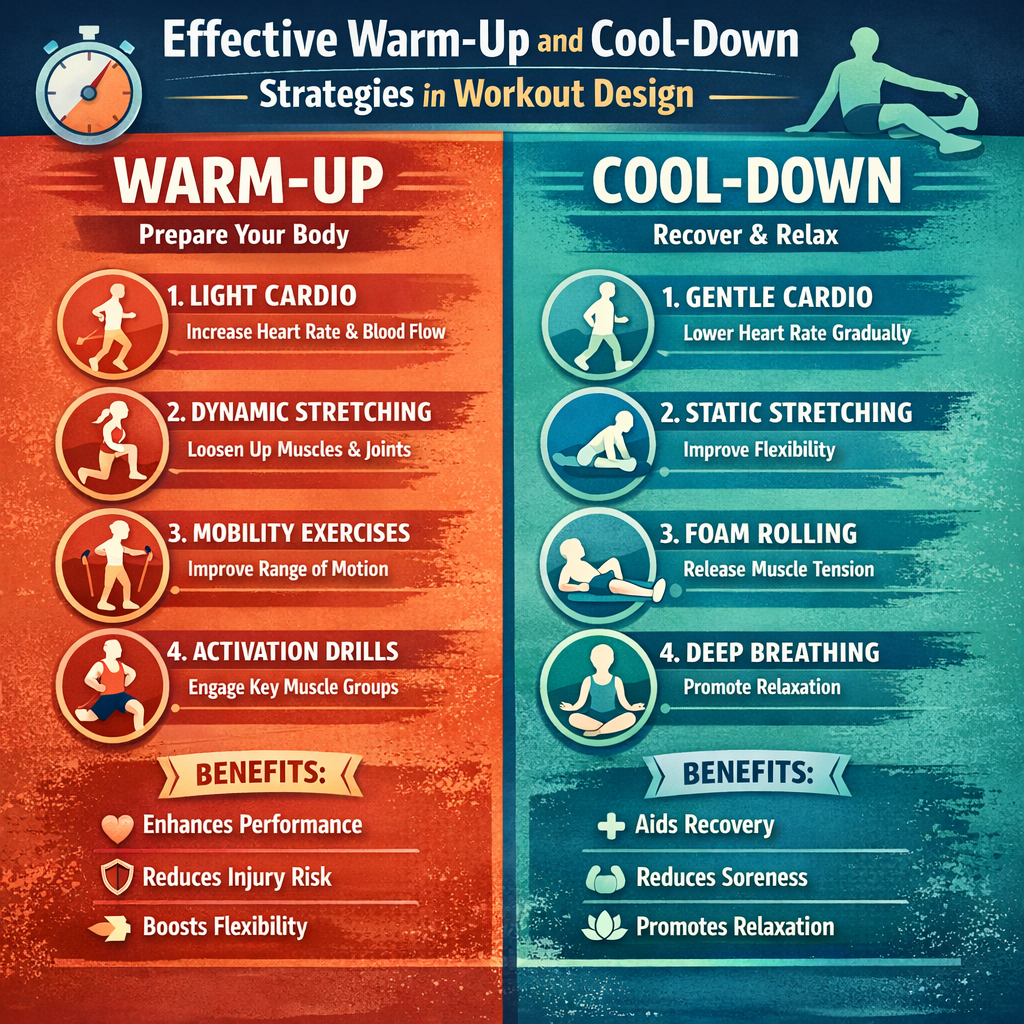
Effective Warm-Up and Cool-Down Strategies in Workout Design
Many individuals neglect the warm-up and cool-down, yet these components are vital for